
February 17, 2026
The small icy moon Enceladus, with its famous water geysers, has an unexpectedly powerful influence on Saturn's entire magnetic field. Data from the Cassini spacecraft has revealed that the moon's influence extends to a record distance of over 500,000 kilometers—more than 2,000 times the moon's radius. This is the first time scientists have observed such a massive electromagnetic reach from such a small body. The Institute of Atmospheric Physics of the Czech Academy of Sciences participated in this international study.
The world was recently surprised by the discovery that the small icy moon Enceladus, located at the edge of Saturn's rings, meets key conditions suitable for extraterrestrial life. The Cassini mission—a unique collaboration between NASA, the European Space Agency (ESA), and the Italian Space Agency (ASI)—has now yielded further fascinating data. It shows that the small icy moon’s influence on Saturn’s environment is far more extensive than experts previously thought.
 "In the space upstream of Enceladus, we discovered a complex web of reflected electromagnetic waves that do not just travel within the orbital plane, but blast high toward Saturn’s north and south poles. Our analysis shows that Enceladus pumps energy into the entire vicinity of the giant planet," says Czech scientist David Píša from the Institute of Atmospheric Physics of the CAS, who is a co-author of the extensive international study. The study was published this February in the Journal of Geophysical Research: Space Physics, a renowned journal in the field of space physics.
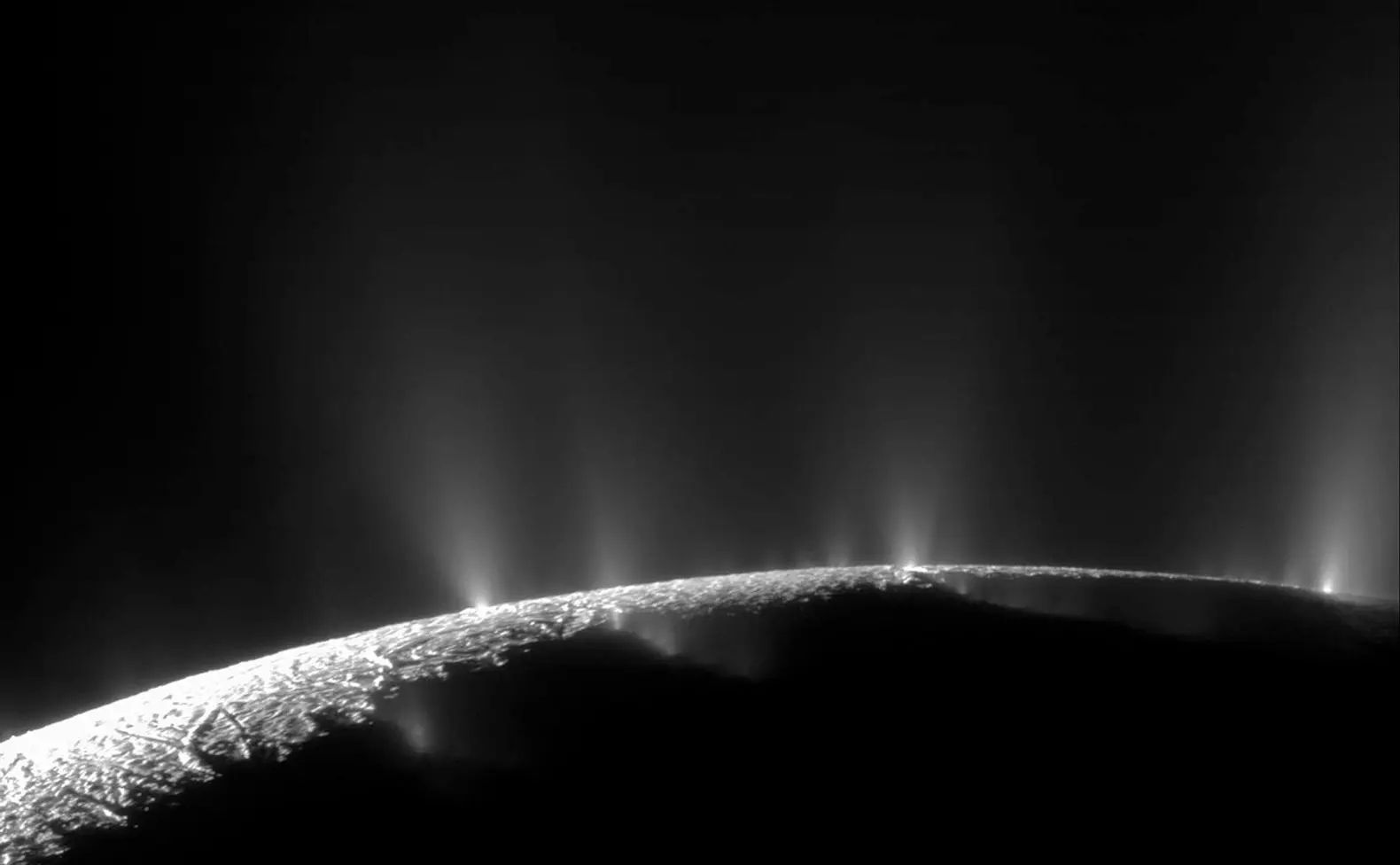
Thanks to the Cassini mission's research, we know that Enceladus is not just a ball of ice, but a geologically very active body. Geysers of water vapor and dust erupt from fissures in the ice surface of Enceladus' southern hemisphere. When exposed to radiation, the water molecules and particles from these plumes become ionized, creating plasma. As this plasma flows around Enceladus, it interacts with Saturn’s magnetic field. This influence is so dominant that it affects energy flows throughout the entire system of Saturn’s moons and rings.
The Invisible Pipelines of Alfvén Wings
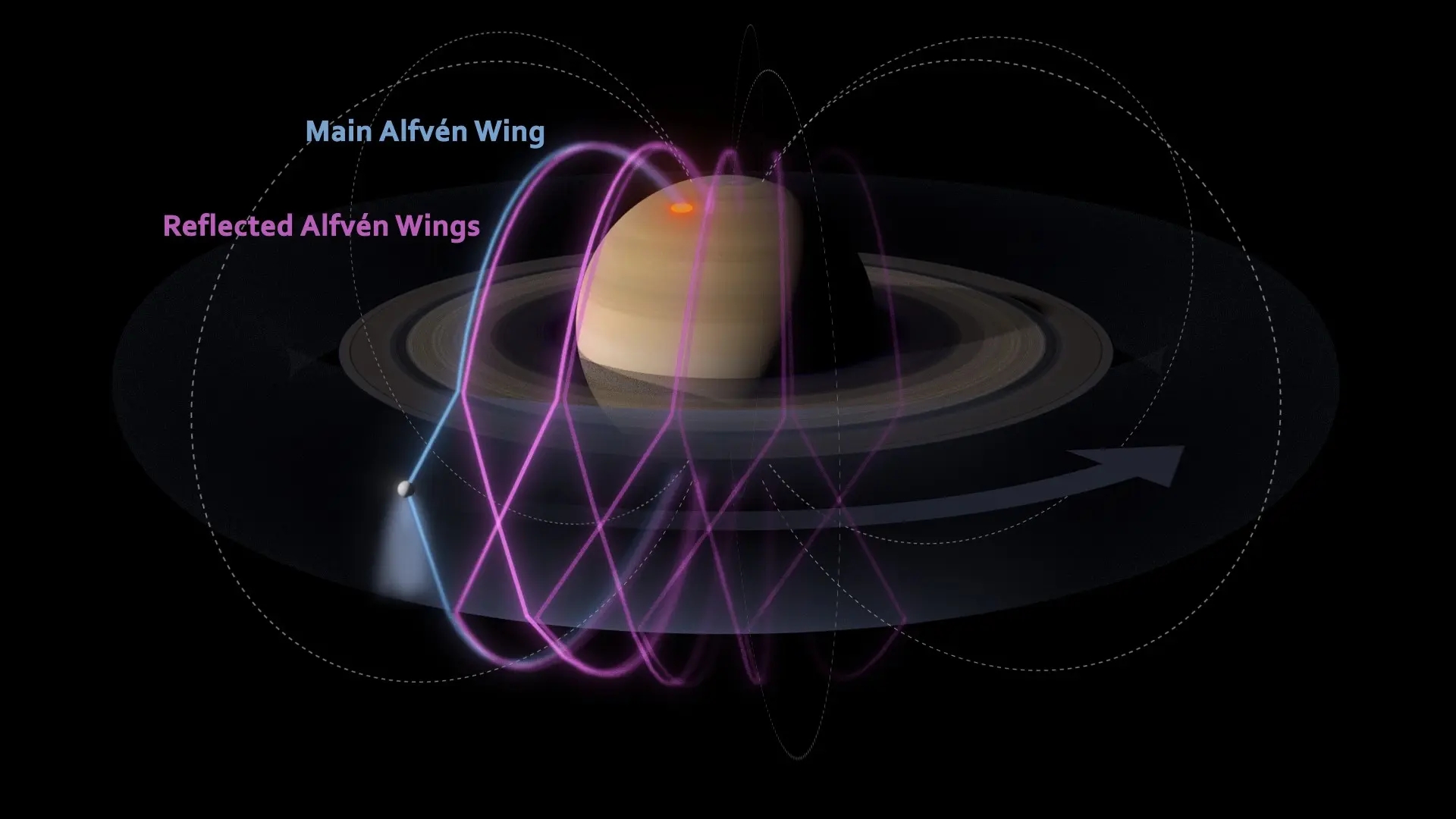 David Píša, a data analysis expert on plasma waves, points out that the research provides new evidence of the phenomenon known as Alfvén wings. These are specific vibrations that propagate along magnetic field lines, much like a wave on a string. Waves in the primary Alfvén wing bounce back and forth between Saturn's ionosphere and the Enceladus plasma torus; in combination with reflected waves, they facilitate a complex exchange of energy between the moon and Saturn's ionosphere.
"These waves function as invisible pipelines for energy transfer along magnetic field lines. Thanks to this, the moon and the planet effectively communicate even over vast distances," the physicist explains.
The research team sifted through thirteen years of archives from four instruments aboard the Cassini spacecraft. In thirty-six instances, the probe entered regions of magnetic connection between the moon and the planet. It was revealed that the waves are not just large and uniform, but that they split into fine filaments due to turbulence. "It is these tiny structures that can alter the trajectories of charged particles, which subsequently create specific auroras at Saturn’s poles," says David Píša.
The new discovery may help scientists understand other unexplored parts of the universe—such as Jupiter’s icy moons or distant exoplanets. In 2040, the European Space Agency (ESA) plans to send another probe to Enceladus, which is intended to land on the moon. Scientists are already working on instruments capable of studying Enceladus' fascinating electromagnetic interactions with Saturn in even greater detail.
Link to study:
- L. Z. Hadid, T. Chust, J.-E. Wahlund, M. W. Morooka, E. Roussos, O. Witasse, J. Rabia, D. Pisa, et al. (2026). Evidence of an extended Alfvén wing system at Enceladus: Cassini’s multi‐instrument observations. Journal of Geophysical Research: Space Physics, 131, e2025JA034657. https://doi.org/10.1029/2025JA034657