
Prague, April 16, 2026
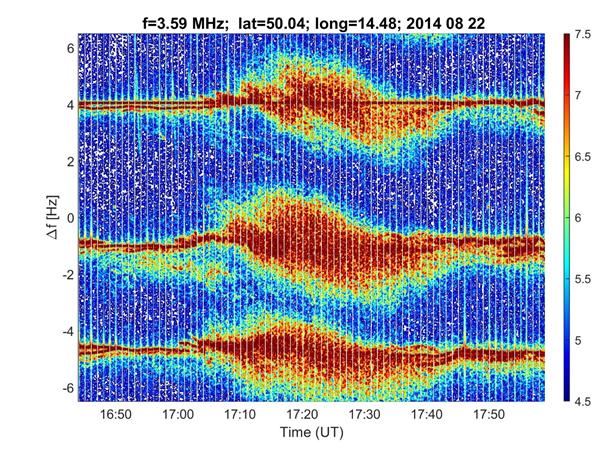
An example of Doppler shift spectrogram. Semitransparent Es layer can be detected as tilted noise structures in each sounding signal path.
Scientists from the Department of the Ionosphere and Aeronomy at the Institute of Atmospheric Physics of the Czech Academy of Sciences have published the first results of measurements of the horizontal drifts of sporadic E (Es) layers in the Journal of Atmospheric and Solar-Terrestrial Physics. These layers, which occur at altitudes approximately between 100 and 130 km, fundamentally affect the propagation of radio signals. Although they have been known for decades, their precise dynamics over Central Europe has not been described in detail using Doppler sounding until now.
A sporadic E layer represents a localized and very sharp increase in electron concentration within a narrow altitude range (typically less than 2 km). For radio waves, it acts as a kind of “mirror” that enables signal propagation over long distances (e.g., the reception of distant VHF stations), but it can also shield measurements of higher regions of the ionosphere.
The team led by Jaroslav Chum utilized a multi-point Continuous Doppler Sounder (CDS) system operating at three different frequencies for the research. “By utilizing the time delays between signals reflecting from different locations, we were able to determine how fast and in what direction these ionospheric structures move,” explains Jaroslav Chum from the Institute of Atmospheric Physics of the CAS.
The scientists analyzed over three hundred occurrences of the semitransparent Es layer, detectable as tilted noise structure in Doppler shift spectrograms (see Figure) and concluded that the average drift speed of these layers is in the tens of meters per second, with the fastest recorded case reaching a speed of 220 m/s. They also confirmed that in summer, the layer occurs primarily during the day, whereas in winter, its activity is more frequent at night.
Understanding the drift of the sporadic E layer is key to refining ionospheric models used by telecommunication services and navigation systems. “Our results regarding drift speeds and azimuths are in good agreement with global models, but for the first time, they provide specific data for the Central European region obtained using this method,” adds Habtamu Marew from the Institute of Atmospheric Physics.
The research shows that the dynamics of the upper atmosphere are closely linked to atmospheric waves and flow (winds) at different heights of the atmosphere, making the sporadic E layer an important indicator of processes throughout the entire atmospheric column.
Link to the publication:
- Marew, H., & Chum, J. (2026). Estimating sporadic E horizontal drift parameters over central Europe: First results from Doppler sounding. Journal of Atmospheric and Solar-Terrestrial Physics, 282, 106807. [DOI: 10.1016/j.jastp.2026.106807]