
Prague, 11 June 2026
The European Space Agency (ESA) at its June meeting proposed the ambitious Plasma Observatory satellite mission as the primary candidate for its next medium-class scientific mission (M7) planned for launch in 2037. The programme, which will explore the plasma environment around Earth, outcompeted rival candidate missions: a two-spacecraft Mars orbiter and a gamma and X-ray space telescope for observing the early Universe.

Areas of Earth’s magnetosphere and the physical processes that the Plasma Observatory will study.
“The Plasma Observatory mission will enable a fundamentally new type of observation of dynamic phenomena in space plasma around the Earth,” says Jan Souček, Director of the Institute of Atmospheric Physics of the Czech Academy of Sciences, who has been involved in the project since its inception and was responsible for coordinating the payload of the proposed mission. This week, the ESA executive has proposed to the Science Programme Committee (SPC) that Plasma Observatory be selected for implementation with a launch foreseen in 2037. The Committee has taken note of this recommendation and will make the formal decision at its next meeting in November 2026.
Plasma, which consists of electrically charged particles (hot, ionised gas), makes up 99% of the visible Universe, and the transfer of energy within it governs how pretty much everything in the Universe works. “Plasma physics is extremely complex because it behaves as a fluid that simultaneously possesses electromagnetic properties. On large spatial and temporal scales, it acts as a fluid; on shorter scales, the ion dynamics manifests while on the smallest scales, the dynamics of free electrons dominates.” explains Jan Souček, a space physicist who is one of the mission proposers and a member of the Science Study Team appointed by ESA. Scientists from the Czech Institute of Atmospheric Physics have thus participated in the project from the very beginning.
For the Plasma Observatory mission, Czech space physicists and engineers will develop a plasma wave analyser, an on-board instrument designed for the measurement and digital analysis of electromagnetic waves in space plasmas. This electronic module converts electric and magnetic signals from spacecraft sensors into a digital form, performing onboard signal processing and detection of physically interesting features within the data. This instrument will enable the transmission of data with a high scientific value to ground within the limited telemetry data rate available to the mission. The development and testing of the electronics unit, including firmware and flight software, will be lead by the team from the Institute of Atmospheric Physics in Prague with contributions from the Laboratory of Physics and Chemistry of the Environment and Space in Orléans, France.
“The team at the Institute of Atmospheric Physics specializes in this type of measurement, and Czech instruments of this kind are already successfully operating onboard the ESA-led Solar Orbiter mission to study the Sun up close, and JUICE, which is currently exploring Jupiter’s icy moons,” notes Jan Souček.
Examples of astrophysical objects in which plasma dynamics play a significant role.
The primary objective of the new mission will be to study how electrically charged particles (plasma) from the Sun interact with the protective magnetic bubble (the magnetosphere) that surrounds Earth. In particular, it would look at how the plasma gains energy through its interaction with Earth’s magnetic field, how this energy enters and moves around the magnetosphere, and how it spreads to other particles around Earth.
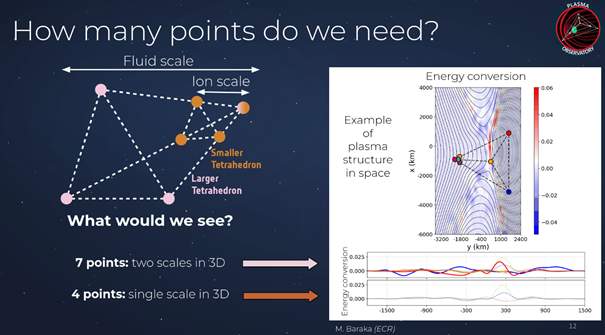
Previous missions, including ESA’s Cluster, found that these interactions happen on different scales in space and time – from a few kilometres up to tens of thousands, and from milliseconds to minutes. But Cluster – made up of four spacecraft – could only study one scale at a time.
Plasma Observatory would be a constellation of seven spacecraft, making it the first mission capable of studying the interactions on different scales of space and time simultaneously. The spacecraft will be separated by distances ranging from tens to thousands of kilometres, allowing scientists to compare data across multiple spatial scales at the same time.
“Combined with computer simulations, this will allow us to understand how particle energization to high energies occurs in space plasmas and how energy is transferred between large and small scales,” emphasizes Jan Souček.
The new programme will also be innovative from a technical perspective. “Progress in the miniaturization of scientific instruments has allowed us to reduce the size and cost of the spacecraft themselves, making it feasible to build multi-spacecraft constellations within the strict cost requirements set by ESA,” points out space physicist Jan Souček.
The constellation of seven Plasma Observatory satellites, covering two spatial scales.
By exploring the magnetosphere, Plasma Observatory will provide a deeper understanding of the wider Universe. “Plasma around Earth serves as a natural laboratory for understanding the wider Universe, including the Sun, exploding stars, supernovas, and distant galaxies where direct measurements are impossible,” concludes Jan Souček.