
March 25, 2026
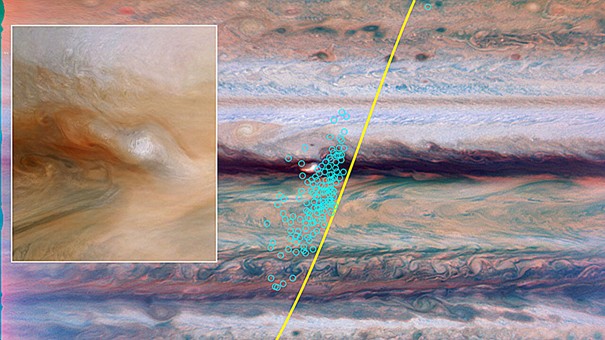
NASA’s Juno spacecraft passed north to south (yellow track) over Jupiter’s atmosphere in August 2022, detecting a cluster of radio pulses from lightning (turquoise circles). A background map from the Hubble Space Telescope identified the lightning source as an isolated “stealth superstorm”. The inset shows a previous stealth superstorm plume from JunoCam data. Credit: NASA/JPL-Caltech/SwRI/MSSS/Björn Jónsson (JunoCam); AGU Advances (2026). DOI: 10.1029/2025av002083; HST and Juno MWR.
A new study published in the prestigious journal AGU Advances investigates lightning activity during so-called “stealth superstorms” (storms invisible in the optical spectrum) on Jupiter. The work, which included significant contributions from scientists at the Institute of Atmospheric Physics of the Czech Academy of Sciences, utilizes data from the Microwave Radiometer (MWR) onboard the Juno spacecraft and presents the first-ever measurement of the radio pulse power distribution of Jovian lightning.
Prior knowledge of Jovian lightning relied primarily on night-side imaging (e.g., the Galileo mission). “A common conclusion from these observations was that the optical energy of lightning in Jupiter’s atmosphere was similar to the highest-energy terrestrial lightning flashes, known as ‘superbolts’. However, this method likely captured only the high-energy tail of the distribution and missed typical lightning activity,” says Ivana Kolmašová from the Institute of Atmospheric Physics of the Czech Academy of Sciences.
The new measurements were made possible by a unique meteorological state in Jupiter’s North Equatorial Belt during 2021–2022. During this time, the region transitioned from an unusually quiescent state into “stealth superstorms”—a phase characterized by isolated convective storms visible primarily in the radio spectrum. Radio waves are another form of electromagnetic radiation produced by lightning and are exceptionally valuable to researchers. They allow for the study of storms even when clouds or other atmospheric components block visual cues.
The isolated nature of these storms allowed researchers to significantly refine the estimate of lightning source power. Analysis showed that the average lightning pulse rate in these storms reached three flashes per second, which is notably higher than previously reported in night-side imaging studies. Furthermore, the MWR instrument likely detected typical lightning pulses rather than just rare high-power outliers.
The study suggests that the radio power of lightning in stealth superstorms may be similar to terrestrial lightning. “Unfortunately, the measurement is subject to significant uncertainty, as energy from multiple lightning discharges can accumulate within a single MWR record (0.1 s), and comparisons with lightning energies measured from Earth’s orbit do not yield entirely definitive conclusions. However, we are currently analyzing lightning whistlers—signal records from the Waves instrument on Juno with much better time resolution—and I hope we will soon refine the conclusions obtained from the microwave instrument,” explains Czech scientist Ivana Kolmašová from the Institute of Atmospheric Physics.
AGU Advances publishes only studies with extraordinary impact. The work of the Czech scientists helps not only in understanding the dynamics of Jupiter’s atmosphere but also provides better insight into the physics of lightning in general. Understanding these processes is crucial for future space missions, such as the European JUICE spacecraft currently en route to Jupiter.
Link to the study:
- Wong et al. (2026). Radio Pulse Power Distribution of Lightning in Jupiter’s 2021–2022 Stealth Superstorms. AGU Advances. Wiley Online Library. https://doi.org/10.1029/2025AV002083